Golden Lane
Would you like to see a street where the houses look more like they were designed for dwarves? Would you like to know what the smallest street in Prague looks like? Then you shouldn’t miss the Golden Lane, or Zlata Ulicka, in the Prague Castle complex.
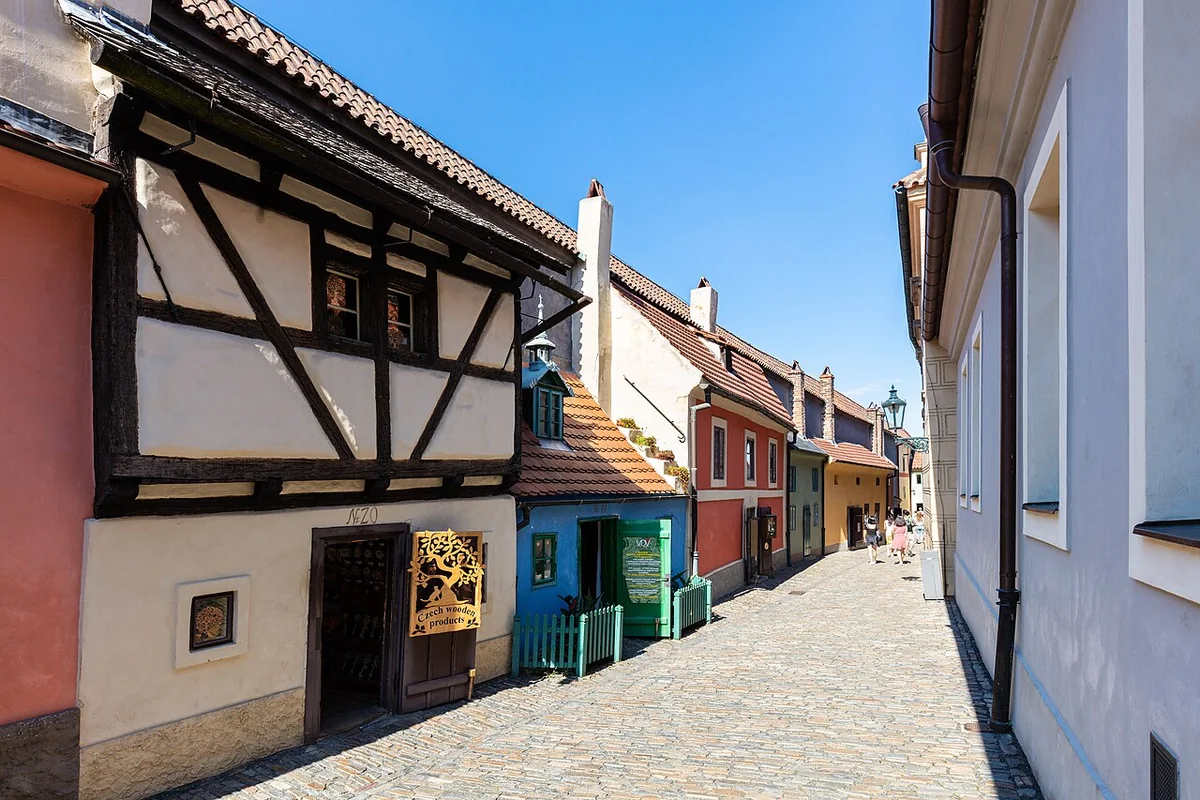
Small Houses and Their Inhabitants
The Golden Lane is also sometimes referred to as the Goldsmith Lane – after the craftsmen who used to live here. The lane is lined with a row of tiny houses which were built into the arches of the Castle fortification wall between the White Tower and the Daliborka tower.
Originally, it was built-up on both sides with the resultant width between the two rows of houses of just one metre. The dwellings were built in accordance with a decree issued by the Emperor Rudolph II in 1597 which stated that the arches in the fortification wall be allotted to the 24 Castle gunners who guarded the gates and the prisons. However, as there were 24 gunners and a distinct lack of space they had to build very small houses for themselves and their families, using stone, mud and wood.
The emperor also prohibited the building of windows facing the Deer Moat, or the selling or renting of the houses to anybody else. In later years, the lane became the refuge of the poor who were unable to gain membership in any of the guilds. The inhabitants of the Golden Lane were mainly gold-beaters, tailors, tapsters and chefs. In accordance with an order issued by one of the Abbesses of the St. George Convent, a part of the lane had to be abolished because the smell, smoke, as well as noise from the tavern disturbing the nearby nunnery.
Famous Inhabitants
The Golden Lane accommodated both rich and poor people alike; artists, clerks, footmen, etc. One of the most famous inhabitants of this street was the writer Franz Kafka who used to work in house no. 22. The Prague prophetess, Madame de Thebes, who was killed by the Gestapo during World War 2, because she predicted the end of the Nazism lived here as well.
The house bearing number 12 was used as a significant gathering place of some of our most important writers and poets – such as Jaroslav Seifert, František Halas.
The legend of Rudolf II’s alchemists
A romantic legend linking the name of the lane with Rudolphian alchemists originated in the 19th century. In fact, alchemists never actually lived in Golden Lane. But according to the legend they not only tried to make the philosopher’s stone or the elixir of youth, but to transform metals into gold.
A tale of an alchemist
Another story tells of a man named Uhle who spent his money on old books and secret experiments. An explosion supposedly brought neighbours to his house, where he was found holding a piece of gold.
The tale belongs to the legends surrounding Golden Lane and Prague’s alchemical imagination. It is not a verified account, but it captures the fascination with turning ordinary materials into gold.